
Google AI Mode: Redefining Search and SEO in the Digital Age
The introduction of Google AI Mode is one of the most transformative moments of the digital world that the world has seen in recent years. This revolution will form a significant change in the way individuals engage with search engines: a keyword-orientated search is replaced by a reasoning-orientated, conversational search that is driven by artificial intelligence. To businesses, marketers and SEO specialists, this is not just another update but a total recreation of the way visibility and engagement operate through the Internet.
Understanding Google AI Mode
Google AI Mode will aim at making search intelligent, intuitive, and personalised. Compared to the traditional model, where the search results are presented as a list of blue links, users type in a query and get the dynamical and contextual answers right within the search results. It takes advantage of deep learning architecture and the Search Generative Experience (SGE) to analyse a query and generate several sub-queries and present a succinctly synthesised answer using credible information.
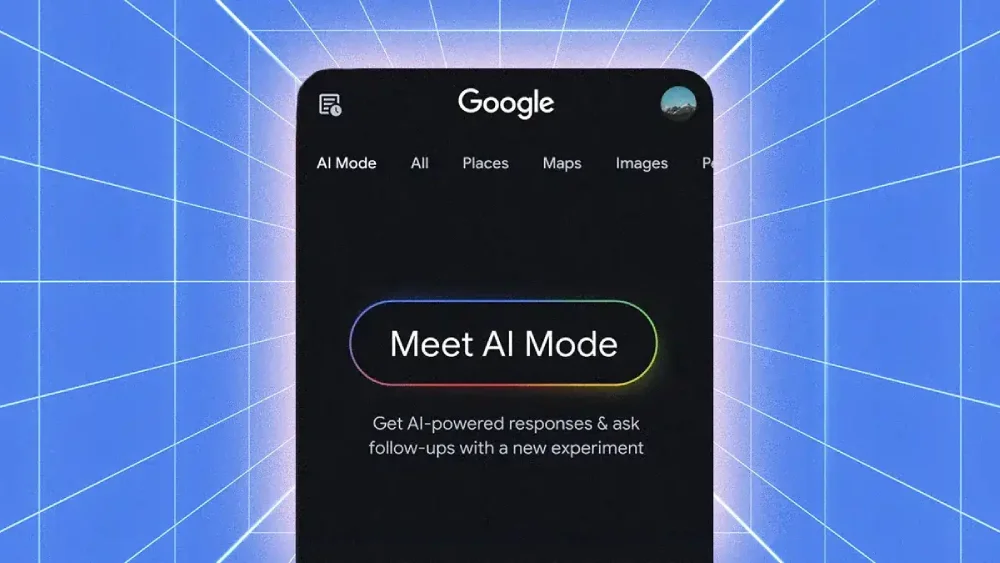
The prompt is normally a special tab named ‘AI Mode‘ that comes along with the normal tabs of ‘All’, ‘Images’ and ‘News’ on the Google search page. When turned on, it transforms the user experience into a more conversational user interface. As an example, a user can pose follow-up questions, narrow the search or request comparisons without having to retype the queries.
Simply put, AI Mode is a combination of generative AI strength and the existing search index of Google – to enable its users to explore more information in less time. It is a kind of a personal chatbot embedded into the search results.
How Google AI Mode Changes Search Behaviour
The recent AI-based interface at Google is a significant step towards the concept of intent and not input. The system understands meaning, relationships and context as opposed to extracting the exact-match keywords. This development comes with various changes that are imminent:
1. Shift from Keyword to Contextual Search
AI Mode is based on semantic understanding. It understands natural language, and thus search is more conversational. It implies that users would enter such queries as ‘ best web design company in Mumbai‘ rather than ‘web design Mumbai’.
2. Rise of Zero-Click Searches
As AI summaries are displayed on the search pages, the user may find what they need without going to any of the websites. Although this is very convenient to the user, this creates new challenges for the website owners and digital marketers who depend on organic traffic.
3. More Visual and Interactive Results
Images, product comparisons, snippets, and charts can frequently be integrated into AI Mode, which makes searching for the product much more interesting. It is not simply about information any longer; it is about presentation, power and clarity.
4. Continuous Conversations
The users are able to pose a follow-up question and receive a contextually relevant response. A conversational loop helps to explore the topics without forgetting what has been asked previously.
The Impact on SEO and Digital Marketing
Google AI Mode is an indicator of a paradigm shift in the field of SEO. Conventional ranking metrics, such as backlinks, keywords, and click-through rates, remain important but now have been relegated to a secondary role and are part of a more complicated system that relies on trust, authority, and user satisfaction.
1. Authority and Expertise Matter More Than Ever
The AI developed by Google will get data that it regards as credible. It means that high-authority websites, the opinion of the experts, and the content supporting real-life experience will be more likely to be mentioned in the AI summaries. In order to establish such authority, companies must publish quality, comprehensive information backed with facts, examples and original views.
2. Content Optimisation Is About Depth, Not Density
The stuffing of keywords is no longer applicable in an AI-based search ecosystem. Rather, it is about the depth, material that will cover a subject matter, foresee questions by the users, and be worth the user. Use of structured content, headings and conversational tone assists AI systems to interpretively present your content better.
3. Rise of Entity-Based SEO
Google has come to view the web as a system of entities, people, places, organisations and things and not necessarily keywords. It is important to ensure your business is being known as a unique, reputable organisation in your field. As an example, when it comes to topical web design companies in Mumbai, your web presence ought to display your work, testimonials and collaborations in such a manner that it associates your brand with the cluster of web design organisations.
4. New Challenges in Traffic Measurement
The AI Mode can decrease the visibly seen site traffic, because a lot of responses are presented on the platform of Google. But even to be listed or quoted in AI summaries creates trust and recognition. The current SEO strategies must not only be concerned with the number of clicks but also with the visibility, mention, and authority of the brand within the ecosystem of Google.
Preparing for the AI-Driven Search Era
Businesses must evolve their digital marketing strategies to remain relevant. Here’s how:
- Invest in Premium Content: Release original research, how-to guides, and case studies that prove authority.
- Adopt Conversational SEO: Work with natural and human language and one that corresponds to the way people pose questions.
- Take Advantage of Organised Data: Schema markup can guide Google to comprehend and present your information in AI Mode search results.
- Centre on Brand Authority: Gain credibility by reviewing, being a thought leader, and branding continuously.
- Showcase Formats: Add videos, infographics, and frequently asked questions — Google AI does not only use text in its searches.
- Measure Performance in a New Way: Measure brand mentions, visibility and engagement, but not page clicks.
Implications for Businesses
It does not matter whether you are in e-commerce, real estate, health, or services on the internet; now the ability to adapt to AI-assisted search is no longer a choice. Organisations that adopt this change will be able to increase their online SEO presence and beat other firms that adopt the old school of .
In the case of a website development company in Mumbai, in particular, the change is a chance to be innovative, to build websites that not only would look beautiful but that would be AI-first indexed and optimised in terms of appearance. Providing customers with information about the performance of their sites in the AI mode can become one of the opening points in the competitive environment of digital services.
The Future of SEO in an AI-First World
Google AI Mode is not just a product feature, but it is also an indication of the future of the web. Search is no longer about the retrieval of pages but the understanding of the users. This development promotes genuineness, creativity and proficiency.
Very soon, we can witness a further integration of search and voice assistants, AR interfaces and multimodal queries. The businesses that perceive these trends and conform to the mind of Google, through the vision of its AI technology, will stand in the best positions to achieve success.
Final Thoughts
Google AI Mode has become the next step in the history of digital marketing. It requests companies to get above the rankings and look at the true value creation. The victors in this new frontier will be those that amalgamate human imagination and an AI-powered approach in creating content and experiences that are a fit with people as well as algorithms.
To all those businesses that want to remain visible and relevant, the message is clear: adopt AI, focus more on being authentic and develop your SEO to meet the next generation of intelligent search.
Disclaimer
The information presented in this blog is derived from publicly available sources for general use, including any cited references. While we strive to mention credible sources whenever possible, Web Design Company in Mumbai does not guarantee the accuracy of the information provided in any way. This article is intended solely for general informational purposes. It should be understood that it does not constitute legal advice and does not aim to serve as such. If any individual(s) make decisions based on the information in this article without verifying the facts, we explicitly reject any liability that may arise as a result. We recommend that readers seek separate guidance regarding any specific information provided here.