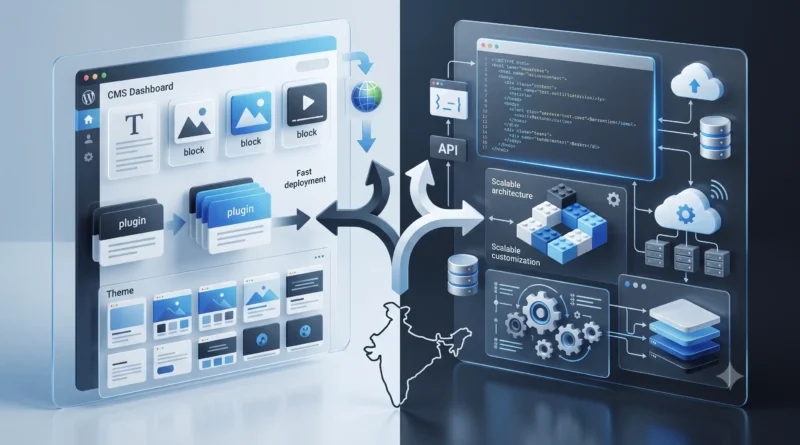
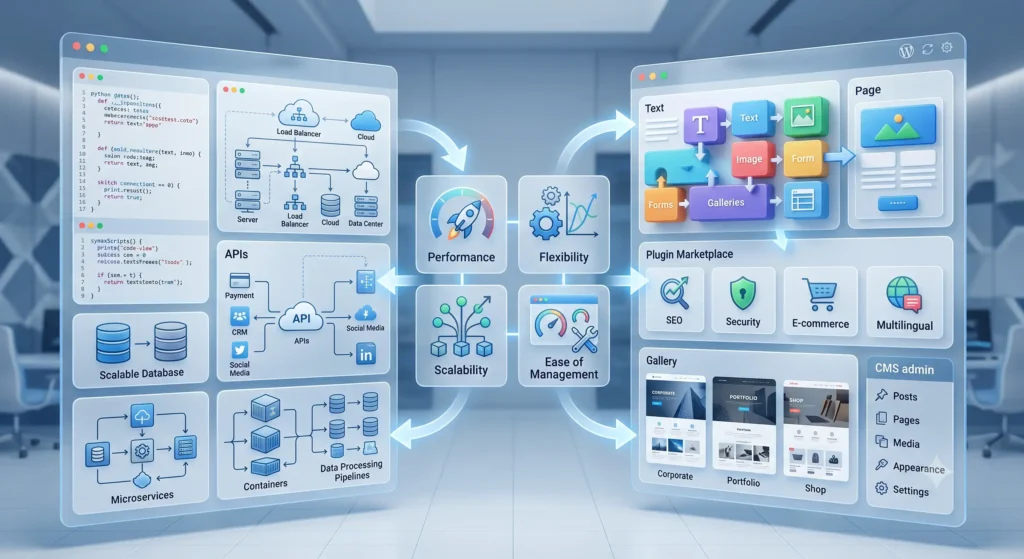
This question comes up in almost every initial conversation I have with a new client. Sometimes it is asked
directly: “Should we go WordPress or custom?” More often it is lurking underneath a different question — “Why is
your quote so much higher than the other company?” — and when I dig into it, I find the other quote was for a
WordPress site and mine was for a custom build, and nobody had explained that these are fundamentally different
things.
The honest answer, by the way, is that for the majority of Indian businesses looking for a website in 2026 —
WordPress is the right choice. Not because it is cheaper (though it usually is), but because it genuinely covers
80% to 90% of what those businesses actually need, and choosing custom development for a project that WordPress
can handle well is like hiring a civil engineer to build a bookshelf.
But there are situations where custom is absolutely the right call. Let me walk through both properly.
WordPress is a content management system. It gives you a database-backed website where content — pages, blog
posts, products, team members — is stored in a database and served dynamically when someone visits. It provides
an admin panel that lets non-technical people log in, add a new service page, update their about section, or
publish a blog post without knowing any code.
WordPress powers approximately 43% of all websites on the internet as of 2026, according to W3Techs’ web
technology surveys. That is not because web developers are lazy. It is because for the majority of websites,
WordPress does the job extremely well.
What WordPress is not: it is not a page builder in itself (though page builder plugins exist), it is not a
drag-and-drop tool in the hands of a professional developer, and it is not the same thing as a WordPress theme
from ThemeForest. A custom-built WordPress website — where a developer writes a theme from scratch — is a
serious piece of software. A WordPress website built on a purchased theme with your logo swapped in is a
completely different product, even though both technically “use WordPress.
The most common technologies used for custom web development in India are PHP with the Laravel or CodeIgniter
framework for the backend, and ReactJS or plain HTML/CSS/JavaScript for the frontend. Some projects use both — a
ReactJS frontend talking to a Laravel API backend.
Custom development is not inherently “better” than WordPress. It is simply different. It gives you complete
control over every aspect of how the system works, at the cost of significantly more development time and
therefore significantly more money. A feature that takes 2 hours to implement in WordPress with a plugin might
take 2 weeks to build from scratch in a custom application.
A basic WordPress website with a custom theme, 5 to 8 pages, contact form, and standard features:
Rs.25,000 to Rs.45,000.
A more complete WordPress website with 10 to 15 pages, multiple custom post types (services, team members, case
studies), advanced forms, and full SEO configuration: Rs.45,000 to Rs.75,000.
A custom-built website with basic functionality, a designed frontend, and a simple admin area to manage
content: Rs.1,00,000 to Rs.2,50,000. And honestly, at the lower end of that range, you should
be asking yourself whether you actually need a custom build — because a good WordPress developer can produce
something comparable for Rs.50,000 and you save Rs.50,000 to Rs.2,00,000.
A custom web application with user authentication, role-based access, database logic, API integrations, and a
proper admin dashboard: Rs.2,50,000 to Rs.8,00,000.
A complex custom platform — multi-tenant, high-traffic, with real-time features, complex workflows, and
multiple integrations: Rs.8,00,000 and upward. Projects at this level are not websites. They
are software products.
Hosting for custom applications also tends to cost more than WordPress hosting, because they often need
dedicated or VPS servers rather than shared hosting — adding Rs.10,000 to Rs.40,000 per year depending on
traffic requirements.
This matters more than most people factor in when making the decision.
A properly built WordPress website for a service business in Mumbai typically goes from kickoff to live in 3 to
5 weeks. Content in, design approved, development done, tested, and live. For a business that wants to start
generating enquiries and building SEO value quickly, that timeline is significant.
A custom website for the same business — same pages, same content, same features — would take 10 to 16 weeks
minimum, because the developer is building the content management system as well as the website. Every hour
spent building a custom CMS is an hour that a WordPress developer does not spend, because WordPress already
gives them a mature, tested, well-documented CMS for free.
The months between when a WordPress site could have been live and when the custom site actually goes live have
a cost. Every month without a live website is a month without SEO building, without enquiries from the website,
without a professional online presence to send potential clients to. That time cost is real even if it does not
show up in the development invoice.
For a new business in Mumbai launching next month and wanting a website live within 4 weeks — WordPress is the
answer almost unconditionally. Custom development simply cannot be delivered responsibly in that timeframe for
anything beyond the most minimal build.
This is probably the most common misconception in the WordPress vs custom debate. A lot of business owners
assume that a custom-built website will rank better on Google because it is “built for their specific needs.
It does not work that way.
Google does not care whether your website is built on WordPress or Laravel or ReactJS or hand-written HTML.
Google’s algorithm evaluates: the quality and relevance of your content, your page loading speed, your mobile
responsiveness, the number and quality of backlinks pointing to your site, your technical SEO structure (meta
tags, heading hierarchy, schema markup, clean URLs), and your E-E-A-T signals (demonstrating expertise,
experience, authoritativeness, and trustworthiness in your subject area).
WordPress, built correctly, handles every one of these requirements well. Plugins like Yoast SEO and RankMath
make SEO configuration straightforward. WordPress generates clean, crawlable page structures. The built-in blog
is a significant SEO advantage — it makes adding content easy, and consistent content is one of the most
reliable long-term ranking signals there is.
I have seen WordPress websites rank above custom-built competitors consistently, and I have seen the opposite.
The platform is not the determining factor. The quality of the content, the technical implementation, and the
ongoing SEO work are what determine rankings.
That said — one area where custom development can have a speed advantage is when WordPress is overloaded with
too many plugins or a heavy theme. A lean, well-built custom website can load faster than a bloated WordPress
site. But a lean, well-built WordPress site with proper caching and image optimisation matches or beats most
custom builds on page speed too. The common variable is how well the development is done, not which platform is
used.
WordPress is actively developed and updated. The WordPress core gets regular updates. Every plugin you install
also updates independently. Themes update. The PHP version on your server needs to stay current. None of these
updates happen in isolation — sometimes a plugin update breaks something else. Sometimes a WordPress core update
changes how a plugin behaves. Managing a WordPress site requires ongoing attention.
If you have someone who actively manages WordPress updates on your site — testing updates on a staging copy
before applying them to the live site, monitoring for conflicts, keeping the PHP version current — WordPress
runs smoothly for years. If nobody is managing it, things gradually stop working in ways that are not always
immediately obvious.
A custom-built website does not have plugin updates to manage — there are no plugins. But it has its own
maintenance requirements. The underlying programming language (PHP, Node.js) needs server-level updates.
Security patches need to be applied. Third-party API integrations change their specifications and need updating.
Features that worked in 2024 may need modification as browser or operating system standards evolve.
Custom maintenance can be more predictable in the sense that changes are less frequent and more deliberate —
you are not managing 15 plugins each with their own update cadence. But when something does need changing in a
custom application, it requires a developer who understands the original codebase. If that developer is
unavailable or the code was poorly documented, the cost of changes goes up significantly.
This is why the quality of documentation and code structure matters so much in custom projects. Well-written,
documented custom code can be picked up by any competent developer. Undocumented code written in an
idiosyncratic style is effectively locked to the original developer — which gives them disproportionate power
over your ongoing costs.
After 12 years of building both, here is my honest list of when a business should choose WordPress:
When your team needs to manage content independently. If someone in your office needs to be
able to add a new service page, publish a blog post, update a team member’s photo, or change a phone number —
WordPress is designed for exactly this. The admin panel is built for non-technical users. A custom CMS built
from scratch is almost always less intuitive.
When you are launching within 6 weeks or less. Custom development of anything meaningful in
under 6 weeks is either not possible or involves cutting corners that will cost you later. WordPress done
properly can be live in 3 to 4 weeks.
When your project is primarily a website, not a system. A business that needs to present its
services, build credibility, generate enquiries, and publish content — that is a website. WordPress is excellent
for this. If the primary purpose is to present information and convert visitors into leads, you do not need
custom development.
When budget is a genuine constraint. An honestly built WordPress website at Rs.40,000 to
Rs.60,000 will serve most small and medium businesses in Mumbai better than a poorly built custom website at
Rs.1,50,000 from a company that rushed the development. Budget constraint should not mean choosing bad
development — it should mean choosing the right tool for the budget.
And here is when you genuinely need a custom build:
When you are building a system, not a website. A booking platform where barbers manage
appointment calendars and clients book slots is a system. An inventory management portal where warehouse staff
track stock levels in real time is a system. A multi-vendor marketplace where multiple sellers list products
independently is a system. WordPress with plugins can approximate some of these — but for complex, specific
business logic, the approximation breaks down.
When you need role-based user access with complex permissions. If different types of users
need to see different things, do different things, and have different levels of access to the same data — and
this logic is specific to your business model — a custom application handles this cleanly. WordPress user roles
exist but are limited for genuinely complex access hierarchies.
When you are integrating with existing proprietary systems. A business that needs its website
to communicate with a custom ERP, a legacy CRM, or a proprietary database in real time typically needs custom
API development. WordPress API integrations exist, but deep integration with non-standard systems often requires
custom code at a level that makes a full custom build cleaner than a WordPress site with complex custom
integrations bolted on.
When scale demands it. A platform expecting hundreds of thousands of concurrent users and
massive data volumes will likely need custom architecture — not because WordPress cannot scale at all, but
because scaling WordPress to enterprise levels requires infrastructure complexity that often makes a custom
build more manageable long-term.
Here is something that comes up less often in this debate but is increasingly the right answer for a specific
type of business.
A hybrid architecture: WordPress as the content management and public-facing website, connected via API to a
custom-built backend for specific application logic.
An example I built for a logistics client in Mumbai: their public website — service pages, about section, blog,
enquiry forms — runs on WordPress. Their internal tracking portal, where staff log shipments and customers track
consignments, is a separate custom Laravel application that shares a database with the WordPress site. Each part
of the system uses the technology it is best suited for.
This approach costs more than pure WordPress but significantly less than a fully custom build, and it gives you
the content management ease of WordPress for the parts of the site that change regularly, combined with the
custom logic power of Laravel for the parts that need it.
Not every project needs this. But for businesses that are outgrowing a simple WordPress site but do not need an
entirely custom platform, it is worth discussing before committing to either extreme.
Choose WordPress if you answer YES to most of these:
Choose Custom Development if you answer YES to most of
these:
Yes, for the right type of business. WordPress is an excellent platform for service businesses, professionals,
educational institutions, healthcare providers, and companies that need a website their team can update
independently. It powers 43% of all websites globally because it genuinely works well for content-managed sites.
Where it becomes the wrong choice is for projects needing complex custom backend logic, very specific user
workflows, or large-scale applications with thousands of concurrent users. For the majority of Indian SMEs
looking for a professional business website, WordPress is a completely appropriate choice.
A professionally custom-designed WordPress website in India typically costs Rs.25,000 to Rs.75,000 for a
business site and up to Rs.1,50,000 for complex WordPress with e-commerce. A custom-developed website built from
scratch starts from Rs.1,00,000 for basic custom builds and goes to Rs.8,00,000 or more for complex
applications. The difference reflects the substantially greater development time required when building without
a CMS foundation.
WordPress is significantly faster. A WordPress business website typically launches in 3 to 5 weeks. A custom
website takes 10 to 20 weeks minimum for anything beyond the most basic build. That time difference has a real
cost in missed enquiries and delayed SEO building.
Yes. Google ranks based on content quality, page speed, mobile responsiveness, backlinks, and technical SEO
structure — none of which are inherently better in a custom build. WordPress, when built and configured
correctly, performs as well as custom websites in search rankings. The platform is not the determining factor.
The quality of implementation and ongoing SEO work are.
Choose custom when your project is a system rather than a website — it requires user logins with complex
role-based permissions, handles and processes significant business data, needs deep integration with proprietary
systems, or is designed to scale to very high concurrent users. For a standard business website, service
company, or portfolio — WordPress done properly handles it extremely well at a fraction of the custom
development cost.
If you are a Mumbai business thinking about a new website and someone has told you that you need custom
development — ask them to explain specifically what about your requirements WordPress cannot handle. If they
cannot give you a clear, specific answer, you probably do not need a custom build.
And if you are comparing quotes and one is Rs.40,000 for WordPress and one is Rs.2,50,000 for custom — make
sure you understand what you are actually comparing. If both are building essentially the same website with the
same pages and features, the Rs.40,000 WordPress option built by an experienced developer is almost certainly
the smarter investment.
We build both at Web Techneeq. We will tell you honestly which makes sense for your project — and if the answer
is WordPress, we will not try to sell you a custom build you do not need. If the answer is custom, we will
explain exactly why WordPress would not serve you and what the additional investment buys you.