
Website Security in the AI Era: What Every Business Must Learn from the Latest IBM Data Breach Report
Introduction
Cybersecurity is no longer a concern only for large enterprises. Modern businesses of every size rely on websites to generate leads, process enquiries, and build customer trust. At the same time, cybercriminals are using AI to automate attacks, making vulnerable websites easier to identify than ever before. Recent IBM research highlights the growing financial impact of breaches and the importance of strong governance and secure development.
AI and Website Security
AI benefits businesses, but it also helps attackers automate vulnerability discovery, phishing, and credential attacks. Businesses should build security into every stage of website development through secure coding, HTTPS, access controls, backups, and regular maintenance.
Why It Matters
An insecure website can result in data loss, downtime, reduced search visibility, and damaged reputation. Investing in secure website development is significantly more cost-effective than recovering from a breach.
Secure Website Development: Your First Line of Defense
Website security begins during development—not after launch. A professionally built website should follow secure coding standards, validate user input, protect databases, and minimize vulnerabilities. Whether the website is built on WordPress, Shopify, Laravel, or a custom framework, security should be integrated into every stage of development.
Essential Security Practices
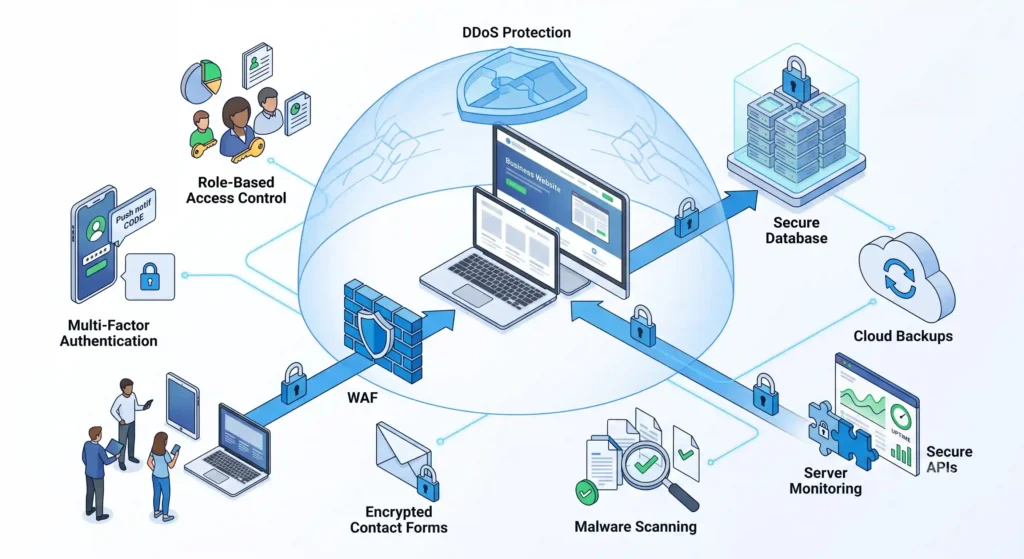
Every business website should implement HTTPS with a valid SSL certificate, strong password policies, multi-factor authentication for administrators, Web Application Firewalls (WAF), regular software updates, automated backups, malware scanning, server hardening, and role-based access control. These measures significantly reduce the chances of successful attacks.
Why eCommerce Websites Need Extra Protection
Online stores handle customer names, addresses, payment information, and order history. Even when payment gateways process card information securely, weak admin panels, vulnerable plugins, or poorly configured servers can expose sensitive customer data. Choosing an experienced ecommerce development company helps ensure that security is built into the shopping experience from day one.
Website Security and SEO Go Hand in Hand
Search engines prioritize trustworthy websites. HTTPS, clean code, fast page loading, secure hosting, and protection against malware all contribute to a better user experience. A hacked website may lose rankings, display security warnings, or be removed from search results until the issue is resolved.
Choosing the Right Development Partner
Businesses should evaluate a web development company based not only on design quality but also on its security practices. At WebTechneeq, our approach combines modern website development, secure coding, SEO best practices, performance optimization, and ongoing maintenance to help businesses build websites that are reliable, scalable, and secure.
Website Security Checklist for Every Business
- Keep your CMS, plugins, themes and server software updated.
- Use HTTPS and renew SSL certificates before expiry.
- Enable Multi-Factor Authentication (MFA) for administrators.
- Perform daily or weekly automated backups.
- Restrict admin access using role-based permissions.
- Install a Web Application Firewall (WAF).
- Monitor website logs and unusual login attempts.
- Scan your website regularly for malware.
- Conduct periodic security audits and penetration testing.
- Choose reliable hosting with proactive security features.
Preparing for AI-Driven Cyber Threats
AI is making cyberattacks faster and more sophisticated. Businesses should move from reactive security to proactive protection by continuously monitoring websites, updating software, training employees, and reviewing security policies. Security should become an ongoing business process rather than a one-time implementation.
Why Businesses Should Invest in Secure Development
A professionally developed website is more than an attractive online presence. Secure architecture, optimized performance, clean coding standards, database protection, API security, and regular maintenance help reduce business risk while improving customer confidence. These investments also contribute to better website performance and long-term digital growth.
How WebTechneeq Can Help
Whether you need a website designing company in Mumbai, a web development company in Mumbai, an ecommerce development company, a Shopify development company, or an SEO company in Mumbai, WebTechneeq focuses on delivering secure, scalable, and search-engine-friendly digital solutions. Our approach combines modern design, secure development practices, technical SEO, website maintenance, and performance optimization to help businesses build a strong online presence.
Conclusion
The latest industry findings reinforce a simple message: cybersecurity is now a business priority, not just an IT concern. As AI continues to reshape both innovation and cyber threats, organizations that invest in secure website development, regular maintenance, and proactive monitoring will be better positioned to protect customer data and maintain business continuity. Building a secure website today is an investment in your brand’s future.
Frequently Asked Questions
1. Why is website security important for small businesses?
Small businesses are increasingly targeted because attackers often assume they have weaker security. A secure website protects customer data, improves trust, and reduces downtime.
2. Can SSL alone protect my website?
No. SSL encrypts data in transit, but websites also need secure coding, regular updates, backups, firewalls, malware monitoring, and access controls.
3. Does website security affect SEO?
Yes. HTTPS, website availability, page speed, and protection from malware contribute to user trust and search engine performance.
4. How often should a website security audit be performed?
At least once or twice a year, and immediately after major updates or suspected security incidents.